Small business marketing is often done with limited information and poor targeting when it comes to audience and message. Before any marketing dollars are spent it is crucial that every business understands who their clients are, what to say., and how to get the message to them.
At Parr Marketing, we always start our free consultations by identifying your Ideal Client Profile (ICP) and narrowing down brand messaging as these are the backbones of any successfull marketing efforts.
We want to make sure every time you meet with us you get valuable information to use in your business for years to come. Whether or not you choose to work with us you will leave your first meeting truly understanding your clients and some strategies to reach them.
Ideal Client Profile and Brand Messaging Services in Western NC

Why Most Marketing Fails Before It Even Starts
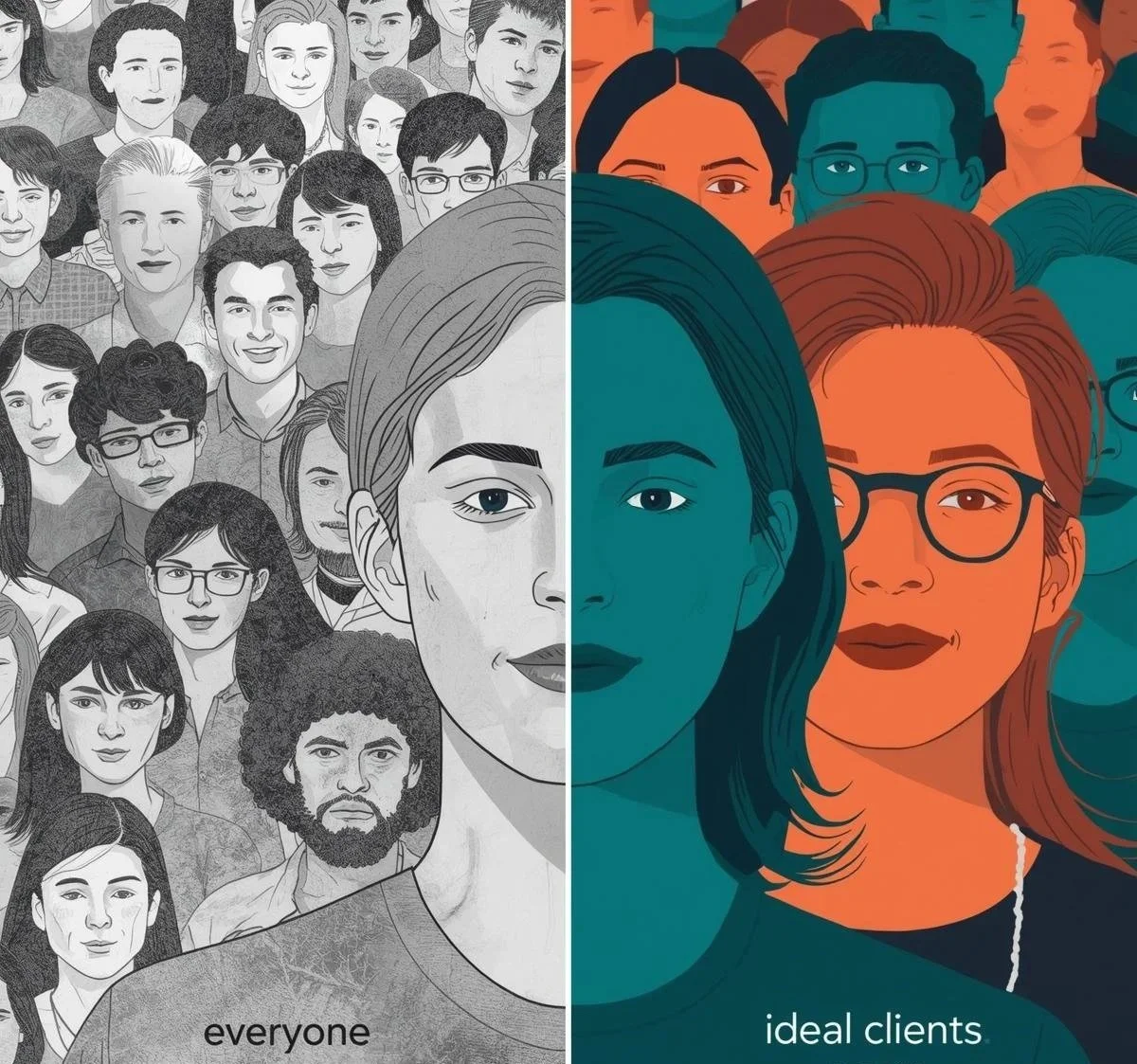
Here's the uncomfortable truth: most small businesses are marketing to everyone, which means they're actually connecting with no one.
You've seen it before: generic website copy that could describe any business in your industry. Social media posts that get zero engagement. Ads that burn through budget without bringing in qualified leads. The problem isn't your product or service. The problem is you haven't clearly defined who you're talking to or what you're actually saying to them.
Before we write a single line of website copy, design a logo, or launch a social media campaign, we start with two fundamental questions:
Who is your ideal customer?
What message will resonate with them?
Get these right, and everything else (your website, your SEO, your social media, your ads) becomes exponentially more effective. Get them wrong, and you're just shouting into the void while your competitors steal your customers.
How I Learned This the Hard Way
Before I started Parr Marketing, I spent 5 years in Florida real estate, listing and selling over 800 homes. I learned something critical in that world: the agents who succeeded weren't the ones with the biggest budgets or the flashiest ads. They were the ones who understood their ideal client so well that every conversation, every listing presentation, and every piece of marketing felt like it was speaking directly to that person.
I saw agents waste thousands on billboards targeting "everyone" while the successful agents I worked with could tell you exactly who their ideal client was: their age, their fears about buying a home, what kept them up at night, and what would make them choose one agent over another.
When I transitioned into marketing and moved to Western North Carolina, I brought that same philosophy with me. But I also brought the scars from watching businesses (including my own early attempts) waste money on marketing that didn't work because we were guessing instead of strategizing.
For years, I tried to rank websites for super high-volume, competitive keywords. I was doing what everyone else did: create massive pages targeting broad terms and hope something stuck. Then I saw a webinar by Edward Sturm about the compact keywords method. I used his approach to rank a page number one overall in 8 hours. I knew immediately this was something special. I paid for the full course, and it supercharged my growth.
But here's what I learned: the compact keywords method only works if you know exactly who you're targeting and what they need to hear. You can find the perfect keyword gap, but if your messaging doesn't resonate with the people searching for it, you've wasted your time.
That's why every client engagement starts the same way: understanding your ideal client profile and defining your brand messaging. Not because it sounds good. Because I've seen what happens when you skip this step, and I've seen the results when you do it right.
What Is an Ideal Client Profile (And Why You Actually Need One)
An Ideal Client Profile (ICP) is a detailed description of the specific person or business that gets the most value from what you offer, and that you love working with.
Notice I didn't say "target audience" or "demographics." Those are too vague. "Women aged 35-55 who like shopping" describes millions of people with completely different needs, problems, and buying behaviors.
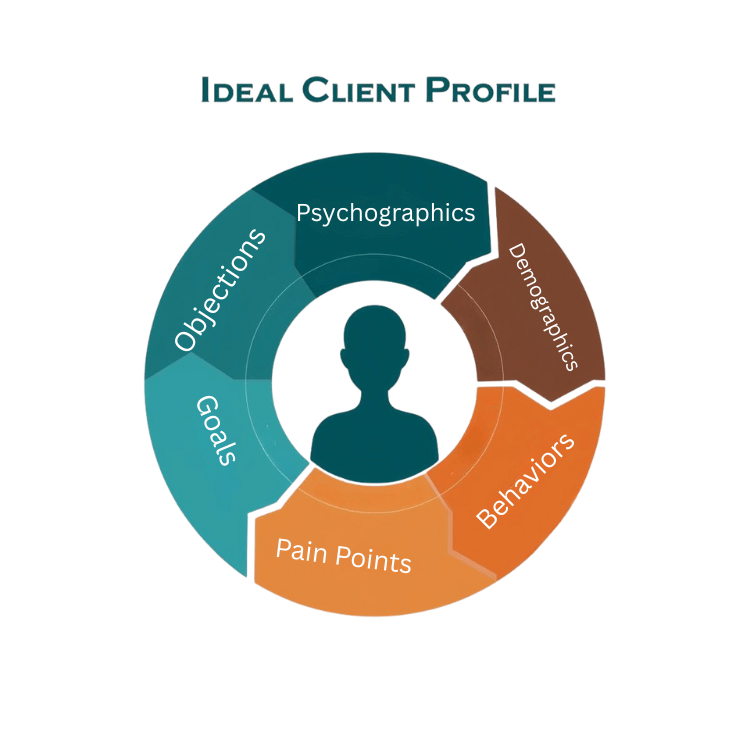
Your ICP goes deeper:
Demographics: Age, location, income level, job title, family situation
Psychographics: Values, fears, aspirations, lifestyle, personality traits
Behaviors: Where they spend time online, how they research purchases, what influences their decisions?
Pain Points: What problems are they trying to solve? What keeps them up at night?
Goals: What are they trying to achieve? What does success look like for them?
Objections: What stops them from buying? What concerns do they have?
When you know your ideal client this intimately, you stop wasting money marketing to people who will never buy. You stop creating content that nobody cares about. You start speaking directly to the people who need you most, and they actually listen. Recently, I listened to an amazing podcast with Jeff Greenfield, who founded the company Provalytics an analytics software that can track a lead during their entire life cycle from the first time they view an advertisement to the eventual conversion that can oftentimes occur weeks or months later. On this podcast, Jeff mentioned that current analytics show 60-70% of most companies marketing budget is waste and going towards clients that have no need/interest in the product or service offered. This shotgun marketing approach can oftentimes produce decent results but when the marketing strategy is properly optimized around the ICP, conversions go through the roof.
Why Brand Messaging Makes or Breaks Your Marketing
You could have the best SEO in the world, driving thousands of visitors to your website. But if your messaging doesn't resonate, they'll leave without calling, without buying, without even remembering your name.
Brand messaging isn't just your tagline or your "About Us" page. It's the consistent voice, tone, and core messages that run through every piece of marketing you do:
Your website copy
Your social media posts
Your email campaigns
Your ads
Your sales conversations
Your customer service interactions
Strong brand messaging answers three critical questions your customers are silently asking:
What do you do? (And why should I care?)
Why should I choose you over your competitors? (What makes you different?)
Can I trust you? (Do you understand my problem and have a real solution?)
Most businesses answer the first question poorly and ignore the other two. Then they wonder why their marketing doesn't convert.
Our Process: How We Build Your Ideal Client Profile
We don't guess. We don't make assumptions. We dig deep to understand exactly who you serve best and what they need to hear from you.
Step 1: The Discovery Session
I like to start every client relationship with a laid-back discovery session. If we can meet in person, I'll bring coffee and fudge from one of my clients (I love spreading their products around). If you're remote, we'll hop on Zoom. Either way, phones are off. We're taking our time. We're not rushing through this.
Why? Because these decisions are some of the most important ones a business can make.
During this session, I ask questions designed to uncover the truth about your business:
"What problems do your customers have, and how do you solve that problem for them?"
This sounds simple, but it's not. Most business owners can tell me what they do, but struggle to articulate the actual problem they're solving from the customer's perspective. A restaurant owner might say "we serve great food," but the real problem they're solving might be "tourists need a memorable dining experience" or "locals want a place that feels like home."
"What are some barriers to entry to your products? If a customer didn't make a decision to purchase your product, what is the most common reason why?"
This question reveals your customers' real objections. Price? Trust? Confusion about what you offer? Overwhelm from too many options? Once we know what stops people from buying, we can address it in your messaging.
I also ask about:
Your best customers (the ones you love working with and who love you)
Your worst customers (the ones who drain your energy and complain about price)
What problems you solve better than anyone else
What you want to be known for
Where you want your business to go in the next 1-3 years
The clients who take this seriously get exponentially better results.
Step 2: Customer Analysis
If you have existing customers, we analyze them:
Who spends the most with you?
Who refers others to you?
Who was easiest to close?
What do your best customers have in common?
Often, business owners are surprised by what we find. The customer you think you're serving isn't always the customer who's actually keeping you in business.
Step 3: Competitive Research
We look at who your competitors are targeting and how they're messaging. This helps us find:
Gaps in the market: Customer segments your competitors are ignoring
Differentiation opportunities: Ways to position you as the obvious choice
Messaging that's overused: Generic claims everyone makes that we should avoid
Step 4: Building Your ICP Document
We synthesize everything into a detailed Ideal Client Profile that includes:
Demographic snapshot: Who they are on paper
Day in the life: What their typical day looks like, what challenges they face
Pain points ranked by urgency: What they need solved first
Decision-making process: How they research, who influences them, what objections they have
Where to find them: What platforms they use, what content they consume, what searches they make
This becomes the foundation for everything we do together. Every piece of content, every ad, every design decision gets filtered through: "Does this resonate with our ICP?"
Why This Matters for SEO (More Than You Think)
You might be thinking: "This sounds like branding work. What does it have to do with SEO?"
Everything.
Google's algorithm has gotten incredibly sophisticated. It doesn't just look at keywords anymore. It evaluates whether your content actually satisfies user intent. Translation: Does your page answer the question people are really asking?
When we build your ICP and messaging first:
We target the right keywords: Not just high-volume terms, but the specific searches your ideal clients actually make
We create content that converts: Because we understand what your audience needs to hear at each stage of their journey
We improve engagement metrics: When people land on your site and the messaging resonates, they stay longer, click more, and convert more often. All signals Google rewards.
We avoid keyword stuffing: Because we're writing for humans who match your ICP, not trying to trick algorithms
We build topical authority: By consistently addressing your ICP's pain points, Google recognizes you as an expert in your niche
The compact keywords method I use for SEO works because we're not creating random content hoping to rank. We're strategically targeting the exact searches your ideal clients make, with messaging that speaks directly to their needs.
Real Results: What Happens When You Get This Right
Case Study: Fine and Dandy Aussiedoodles

Let me tell you about Laney, who owns Fine and Dandy Aussiedoodles.
She originally started her breeding business in Arizona and Nevada and had built a solid reputation there. When she moved to Western North Carolina a few years ago, she made an assumption that a lot of transplants make: she thought her Arizona/Nevada brand was her real asset, so she kept all her marketing focused on that region.
In her mind, people in Western NC probably weren't interested in her type of dogs. She was looking at the wrong market.
When we started working together, we did what we always do: deep research into her ideal client profile. And we discovered something she hadn't considered.
The Reality: Western North Carolina has a massive doodle population and a huge need for ethical, high-quality breeders. Here's what made it even more interesting: there are literally no rules, regulations, or even licensing requirements for dog breeders in WNC. That means the market was flooded with backyard breeders and puppy mills, but families desperate for a well-bred, healthy dog from an ethical source had very few options.
The Opportunity: Laney wasn't just another breeder. She was an ethical breeder with years of experience, health testing, and a genuine love for her dogs. She was exactly what Western NC families needed, but they didn't know she existed because all her marketing pointed to the Southwest.
What We Did:
Ideal Client Profile: We identified that her ideal customers weren't in Arizona anymore. They were right here: WNC families who wanted a healthy, ethically-bred doodle and were willing to pay for quality because they'd heard horror stories about bad breeders.
Messaging Overhaul: We completely rebuilt her website and marketing to speak directly to Western NC families. Instead of "serving Arizona and Nevada," we focused on "ethical breeding in Western North Carolina." We addressed the specific concerns local families had: health testing, transparent practices, and the peace of mind that comes from working with someone who truly cares about their dogs.
We even highlighted that she offers North Carolina residents a discount, which reinforced that she's part of the community now, not just operating here.
SEO Strategy: We used the compact keywords method to target specific searches like "Aussiedoodle breeders Western NC," "ethical dog breeders near Asheville," and "healthy doodle puppies North Carolina." These weren't massive search volume keywords, but they were exactly what her ideal clients were typing into Google.
The Results: Laney went from essentially ignoring the local market to dominating it. She's now selling tons of dogs in the area, working with families who are thrilled to find an ethical breeder, and she's built a waiting list of people who want her puppies specifically because of her reputation for quality and care.
All because we helped her see that her ideal customer wasn't who she thought, and her messaging needed to speak to the people right in front of her.

Case Study: Heavenly Fudge
Here's another example of how understanding your true ideal client changes everything.
When I started working with Heavenly Fudge, their main focus was trying to bring in more locals. It made sense on the surface: build loyalty with the community, create regulars, establish yourself as a local favorite.
But when we dug into their actual business data and did market research, we discovered something different: tourists and online traffic were the real source of their revenue. Locals were great, but they weren't the ones driving the bulk of sales.
The Shift: Instead of fighting against their natural market, we leaned into it. We focused our SEO and marketing efforts on reaching tourists planning trips to the area and people across the country who wanted to order fudge online.
We still created a locals discount as a genuine thank you and "we love you" to the community. But we stopped pretending that locals were going to be their primary revenue source.
The Results: Within four months, they had multiple weeks where online sales exceeded the entire rest of the year combined. Zero ad spend. Just strategic positioning and messaging that resonated with the people who actually wanted to buy.
That's what happens when you stop making assumptions about your market and start doing real research to understand who actually needs what you offer.
Common Mistakes We See (And How to Avoid Them)
Mistake #1: Thinking "Everyone" Is Your Customer
If everyone is your customer, no one is. The businesses that win are the ones that specialize and own a specific niche.
I'll be honest: sometimes clients push back on this. They worry that narrowing their focus means turning away business. But here's the reality: the business owners I work with are very smart, and deep down they know they have a niche. They know who their best customers are. They're just scared to say it out loud.
Once we identify that niche and build messaging around it, something magical happens: they actually attract more of the right customers. The people who are perfect fits see themselves in the marketing and reach out. The tire-kickers and price-shoppers move on to someone else. Everyone wins.
Mistake #2: Making Your Messaging About You Instead of Them
Your customers don't care about your company history or your mission statement. They care about whether you can solve their problem. Your messaging should focus on them: their pain points, their goals, their needs.
Mistake #3: Using Industry Jargon That Customers Don't Understand
You might know what "integrated digital marketing solutions" means, but your customers just want more phone calls and website traffic. Speak their language, not yours.
Mistake #4: Copying Your Competitors' Messaging
If you sound like everyone else in your industry, you're just adding to the noise. Differentiation requires saying something different, not just saying the same thing louder.
Mistake #5: Setting It and Forgetting It
Your ICP and messaging aren't static. As your business grows, as markets change, as you learn more about your customers, you refine and evolve. We revisit this work regularly with clients to ensure it stays relevant.
Who This Process Is Perfect For
This foundational work isn't for every business. It's specifically valuable if:
✓ You're launching a new business and want to start with strategy instead of guessing
✓ Your marketing isn't working and you can't figure out why
✓ You're getting traffic but not conversions (people visit but don't buy)
✓ You feel like you're marketing to everyone and connecting with no one
✓ You've been in business a while but your messaging feels stale or generic
✓ You want to differentiate yourself in a crowded market
✓ You're ready to stop wasting money on marketing that doesn't work
Why We Do This First, Before Everything Else
A lot of agencies will jump straight into building you a website or running ads because that's how they make money faster.
We don't do that.
If we build you a beautiful website with unclear messaging, it's a waste. If we drive traffic to a site that doesn't convert because it's not speaking to the right people, we just burned your ad budget.
Starting with your ICP and messaging means every dollar you spend after that works harder. Your website converts better. Your SEO targets the right people. Your ads resonate. Your social media builds genuine connections.
It's the difference between throwing darts blindfolded and aiming at a clear target.
Why Western North Carolina Is Different
When I first moved to Waynesville, I was unpacking my car and going back and forth to my apartment. My neighbor across the street, Denny, called me over. He offered me a cup of coffee and then spent the entire day getting to know me and helping me get settled.
Denny is literally like my grandpa now.
That moment showed me everything I needed to know about Western North Carolina. This isn't a place where people are trying to get ahead at each other's expense. It's a community where people genuinely care about each other, where relationships matter, and where your word still means something.
That's why I love working with small businesses here. The business owners I meet aren't just chasing profits. They care about their customers. They care about their community. They're building something they're proud of.
When you approach marketing with that same authenticity, when your messaging reflects who you really are and genuinely serves your customers, it works. People can tell the difference between a business that cares and one that's just trying to extract money.
Why I'm Selective About Who I Work With
I'll be honest with you: I don't take on every client who has a budget.
I've learned that the best results come from working with business owners who genuinely love what they do. When you're passionate about your business, when you care about your customers, when you want to build something meaningful in this community, that energy is infectious. It makes the work better, and it makes the results better.
I've worked with insurance agents who truly care about protecting families. Restaurant owners who lose sleep over making sure every dish is perfect. Retail shop owners who know their regular customers by name. Breeders who health-test their dogs and genuinely care about the families they're placing puppies with. Those are my people.
If you're just trying to maximize profit with the least amount of effort, we're probably not a good fit. But if you're building something you're proud of and you want marketing that reflects the quality of your work, then let's talk.
I moved to Western North Carolina because of the genuine, hardworking people building businesses in this community. I want to help those businesses thrive, not just collect a monthly retainer.
How to Get Started
If you're a small business owner in Western North Carolina who's tired of generic marketing that doesn't move the needle, let's talk.
We'll start with a free consultation where we'll discuss:
Who you're currently trying to reach
What's not working with your current marketing
Whether this foundational work makes sense for your business
What results you could realistically expect
No pressure. No hard sell. Just an honest conversation about whether we're a good fit to help you grow.
Maybe we'll grab coffee. Maybe I'll bring some fudge from one of my clients. Either way, we'll take our time and figure out if working together makes sense.
Because at the end of the day, I only want to work with business owners who genuinely love what they do and are ready to invest in doing marketing the right way.
If that's you, let's build something great together.